What is Jev? Clearing hype around!

I am a 18 y/o web developer , User Interface Designer and Python Programmer from India.
I love to share my experiences with people all over the internet.
Connect with me and have a great time reading the blogs.
For the past two years, the tech world has been obsessed with making AI better at talking to humans. But what happens when AI needs to talk to software?
If you are a developer, you have likely run into the friction of using large language models (LLMs) like GPT- 5 or Claude for backend tasks. You ask the model to classify an email, return a JSON object, or make a simple true/false judgment. In response, you wait several seconds and pay a premium just to get a heavily formatted text string: which occasionally hallucinates an invalid JSON bracket and breaks your entire pipeline.
Using an LLM for simple programmatic decisions is like hiring a philosophy professor to sort your mail. It works, but it is incredibly slow, expensive, and architecturally over-engineered.
Here enters Jev, a groundbreaking new frontier model by TypeSafe AI (founded by Diogo Almeida, a co-creator of ChatGPT and RLHF). Jev is flipping the script on AI application development. It does not write text. It does not generate chat. Instead, it acts as a ridiculously fast, lightning-cheap decision engine that behaves exactly like a typed function call. Here is a deep dive into what Jev is, how it works, and why it is about to change how we build AI-native software.
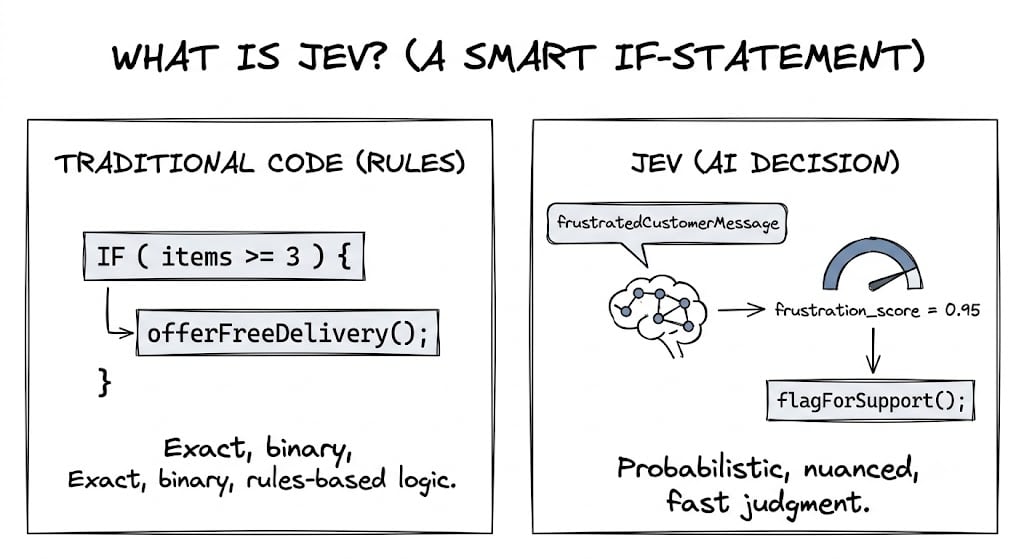
The System 1 Architecture
The name "Jev" is a nod to the Jevons paradox (where falling costs increase demand), but its architecture is inspired by Daniel Kahneman's famous psychological concept of System 1 and System 2 thinking.
Current LLMs are System 2 thinkers. They are autoregressive, meaning they generate responses slowly, deliberate over reasoning, and write out output one single token at a time. This is great for writing a college essay or summarizing a 100-page PDF.
Jev is built for System 1 thinking: fast, automatic, intuitive, and deterministic. It takes an unstructured input (called "State") and instantly returns structured, probabilistic decisions. Because it evaluates data in a single parallel pass rather than predicting tokens sequentially, the speed gains are astronomical.
How Jev Works: State & Question Architecture
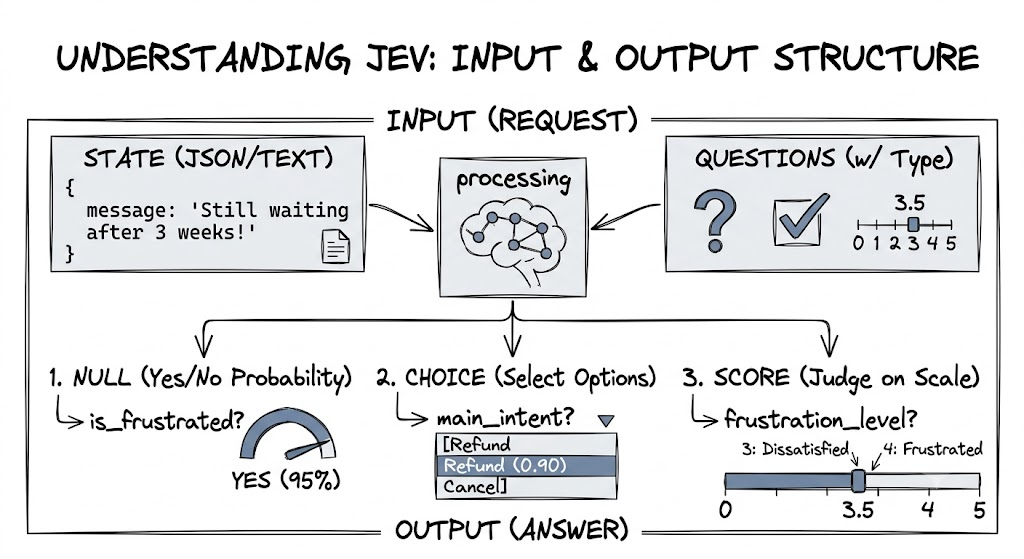
When you ping an LLM, you hope it returns the string you asked for. When you query Jev, you strictly define the shape of the answer upfront using three available data primitives:
Noul (Null/Boolean): A simple yes/no judgment. (e.g., "Is this customer angry?")
Choice: Picking exactly one option from a pre-defined set of up to 255 categories. (e.g., "Route this ticket to: Sales, Billing, or Tech Support.")
Score: Ranking something on a defined scale. (e.g., "Rate the urgency of this request from 1 to 10.")
Because Jev only outputs these exact typed values, schema hallucination is mathematically impossible. It literally cannot invent a new tool name or misspell a category. Better yet, every single answer comes with a calibrated confidence score based on RLCD (Reinforcement Learning for Calibrated Decisions). If Jev is 98% confident, you can route the task automatically. If it drops to 60%, your code can gracefully branch the task to a human agent.
What Actually Makes Jev Different Under the Hood?
The true magic of Jev lies in its benchmarking against traditional conversational models.
⚡ Blazing Fast Latency
Because Jev evaluates all your questions about a piece of state in parallel, its latency is entirely decoupled from the length of the output.
In a benchmarked demonstration, a standard reasoning model (like GPT-5.6 Terra) took 8.5 seconds to process a judgment task. Jev completed the exact same task in 114 milliseconds.
Real-world end-to-end response times hover between 70ms to 500ms, meaning Jev is fast enough to run inside a tight, real-time code loop.
💸 Ground-Floor Pricing
Pricing for traditional LLMs can easily kill a startup's margins, ranging from $0.20 to $10.00 per million input tokens, plus heavy output fees.
Jev costs $0.042 per million input tokens.
Output tokens? Completely free.
To put that in perspective, Jev is roughly 170x to 400x cheaper than comparable LLM classification tasks. You could analyze tens of thousands of data points for a single dollar.
Practical Use Cases for Production
Because of its speed and reliability, Jev opens up use cases that were previously impossible (or economically unviable) with autoregressive models:
Real-Time Gaming: Developers are using Jev to control agents in real-time. Demos already show Jev playing Minecraft, dodging trains in Subway Surfers, and acting as the AI brain for guards in a heist game:making split-second decisions at 10+ frames per second.
LLM Guardrails: Using Jev as a gatekeeper. Before sending an expensive query to GPT-4, Jev evaluates the prompt to deny, ask, or allow the tool call based on security policies, taking mere milliseconds to protect your system.
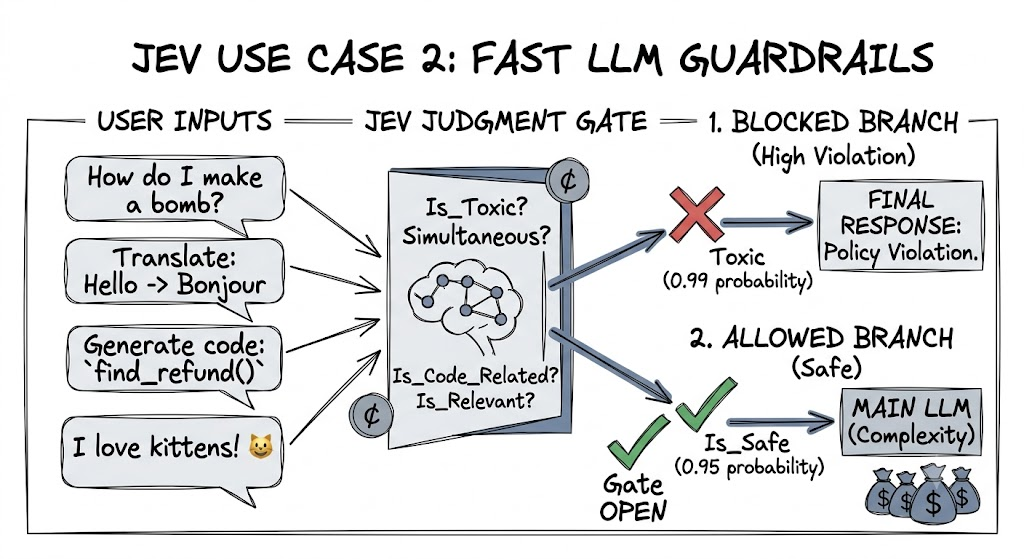
Massive Data Triage: Routing thousands of incoming support emails, sorting PostgreSQL database entries via plain-language filters, or categorizing giant datasets where using an LLM would bankrupt the project.
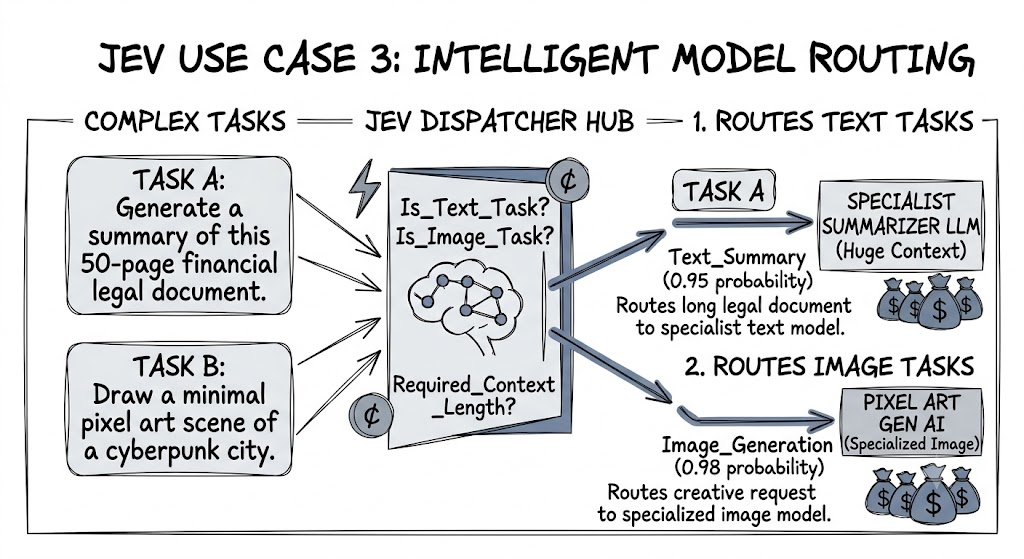
Example Use Case : Multi-Dimensional Scoring (The "Content Moderation Guardrail")
If you ask an LLM, "Is this text bad?", it struggles with nuance. Jev allows you to break a fuzzy judgment into independent dimensions, score each atomically, and evaluate them in parallel without increasing latency.
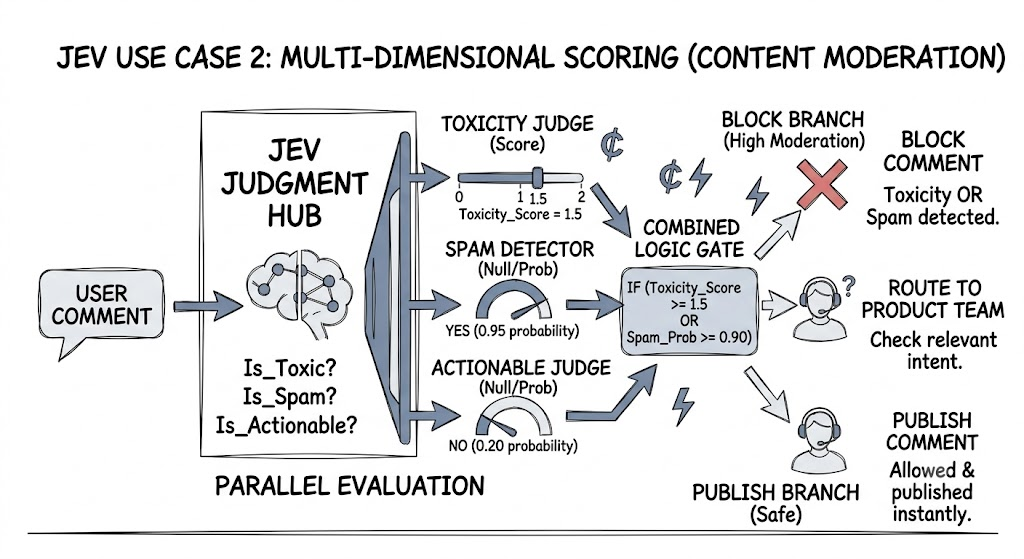
The Scenario: A user-generated content platform (like a forum or comment section). The Goal: Block toxic content instantly before it renders on the page.
from typesafe_sdk import TypeSafeClient, Score, Null

client = TypeSafeClient()

state = "Your product is complete garbage and the developer who wrote this should be fired immediately."

# Evaluate 3 different guardrails simultaneously
result = client.system_one(
    state=state,
    questions={
        "toxicity": Score(
            instructions="How toxic or hostile is this message?",
            levels={
                0: "Polite and constructive",
                1: "Frustrated but professional",
                2: "Hostile, insulting, or abusive"
            }
        ),
        "is_spam": Null("Does this message look like promotional spam or a bot?"),
        "is_actionable": Null("Does the user describe a specific bug or feature request?")
    }
)

# Access the parallel results
toxicity_level = result.answers["toxicity"].score
spam_prob = result.answers["is_spam"].probability

if toxicity_level >= 1.5 or spam_prob > 0.95:
    block_comment()
elif result.answers["is_actionable"].probability > 0.80:
    route_to_product_team()
else:
    publish_comment()
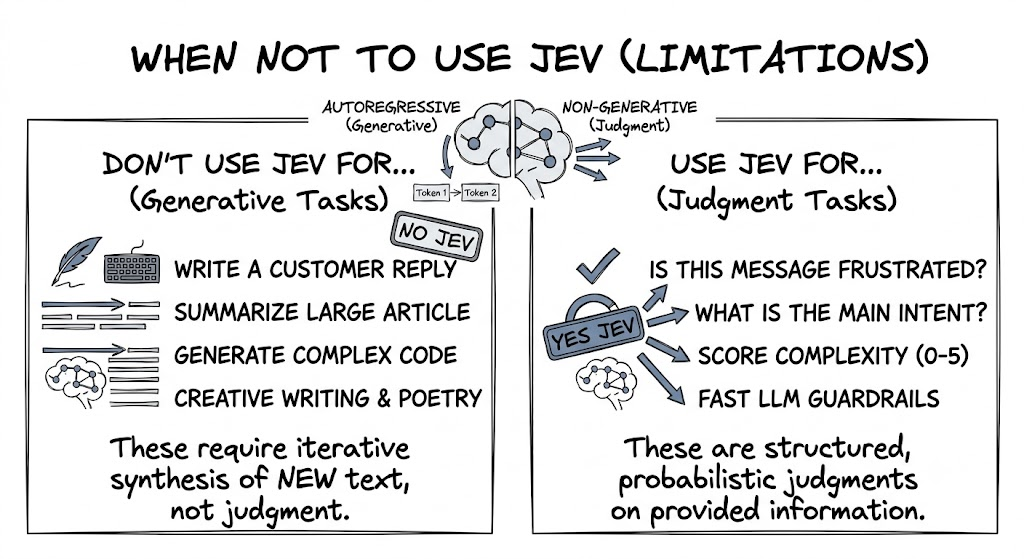
Where Jev Fails (The Limitations)
Jev is not a silver bullet. Because of what it is optimized for, there are several things you should never use it for:
Writing Text: It literally cannot generate strings. If you need a summary or an email drafted, use Claude or GPT.
Math and Counting: Jev is not a calculator. It struggles with arithmetic and date comparisons.
Multi-Hop Reasoning: Jev excels at immediate intuition based on the provided state. It cannot chain logic or "think through" complex, multi-step word problems.
That's pretty much it from this blog.
Read more about Jev here : https://typesafe.ai/blog/introducing-system-one-models-and-jev
Connect with me?
https://linkedin.com/in/adityacodes